
 اللغة العربية
 Български
 Čeština
 Dansk
Dansk Deutsch
 Ελληνικά
 English
 Español
 Suomi
Suomi Français
 हिन्दी
 Magyar
 Italiano
 日本語
日本語 한국어
한국어 Nederlands
 Norsk
Norsk Polski
 Português
 Română
 Русский
 Svenska
 ภาษาไทย
 Türkçe
 中文
中文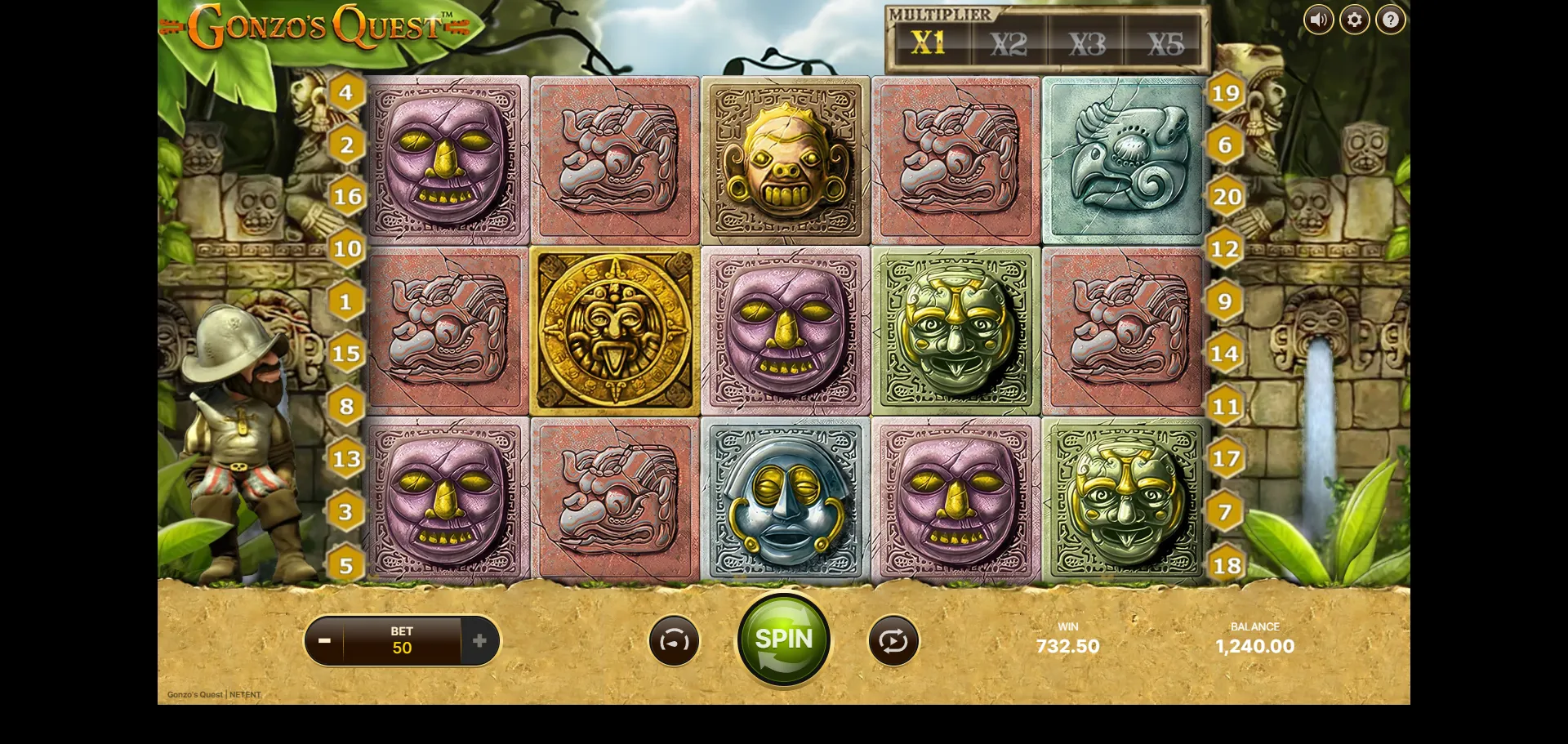

Introduction
Gonzo's Quest came out in 2011 as a NetEnt release with two mechanics that other studios picked up afterwards: cascading reels and per-spin multiplier counter. I ran 523 spins in the NetEnt demo across a manually conducted session, tracking hit rate, dry streak behavior, and how the multiplier counter interacts with the Avalanche chain. The game character - Gonzo himself - stands to the left of the reels throughout the entire session and reacts visibly to each result: an exaggerated jump and arm raise on a win, an impatient foot tap during losing spins. The animation functions as a win signal without a counter check required. Free Falls did not trigger in my session, which I will note explicitly where it is relevant. The RTP is published directly on the in-game Rules, not sourced from an aggregator, which puts it in a smaller category than most published RTP figures actually are.
Core Mechanics: Avalanche Cascade and Multiplier Counter
Gonzo's Quest runs on the Avalanche feature rather than rotating reels: symbols fall from above, winning combinations shatter and disappear, and remaining tiles drop while new ones fill in from the top. I tracked this across the session - the visual distinction from standard reels is immediate, and the practical consequence is that a single spin event can produce multiple sequential evaluations at the same bet size.
The multiplier counter runs alongside this. Each Avalanche within a spin advances it: 1x, 2x, 3x, 5x in the base game. A non-winning result resets it to 1x for the next spin. The practical effect is that the value of any win in a chain depends on how many cascades have already landed in that spin. A third-cascade win at 3x is triple the value of the same combination on the first cascade. The counter shows where you are in the chain - that affects how much each cascade win pays.
The grid uses 20 fixed paylines evaluated left to right from reel 1, without gaps. Wins on multiple lines are summed. Only the highest win per line counts - not each individual outcome on that line. Payline numbers stay visible along both sides of the reel frame throughout every spin: 1 through 10 on the left column, 11 through 20 on the right.

Free Falls Bonus: 15x Multiplier and Retrigger
Three Free Fall scatter symbols on reels 1, 2, and 3 - in succession from the leftmost reel, on an active payline - award 10 Free Falls. The trigger condition is strict: the scatters need to land on exactly those three reels in that order. A scatter anywhere else on the grid does not count. If three more scatters appear during Free Falls, 10 additional Free Falls are added.
During Free Falls the multiplier sequence changes from the base game. Instead of 1x, 2x, 3x, 5x, it runs 3x, 6x, 9x, 15x. The floor is 3x - the minimum win during any Free Fall is already at 3x before the first cascade. The multiplier does not reset between Free Falls spins; it only resets if a non-winning Avalanche ends a chain within a single free spin.
That is the mechanism behind the 2,200x maximum win. The path requires a Free Falls trigger, a sustained Avalanche chain advancing the multiplier to 15x, and high-value symbols across multiple paylines simultaneously. The top symbol - the silver-blue Aztec mask - carries the largest 5-of-a-kind in the paytable. During Free Falls the 15x multiplier applies on top of that base payout, so the same line pays fifteen times its base value before any further Avalanche stacking.
In my 523 spins, Free Falls did not trigger. Expected Free Falls frequency works out to roughly one trigger per 125 spins - about four in a session this size. Free Falls not triggering in 523 spins is within normal variance for this game - but it means I cannot describe the Free Falls screen from direct observation. The mechanics above come from the in-game Rules, not external aggregators.

Wild Symbol: Reels 2-4 Only
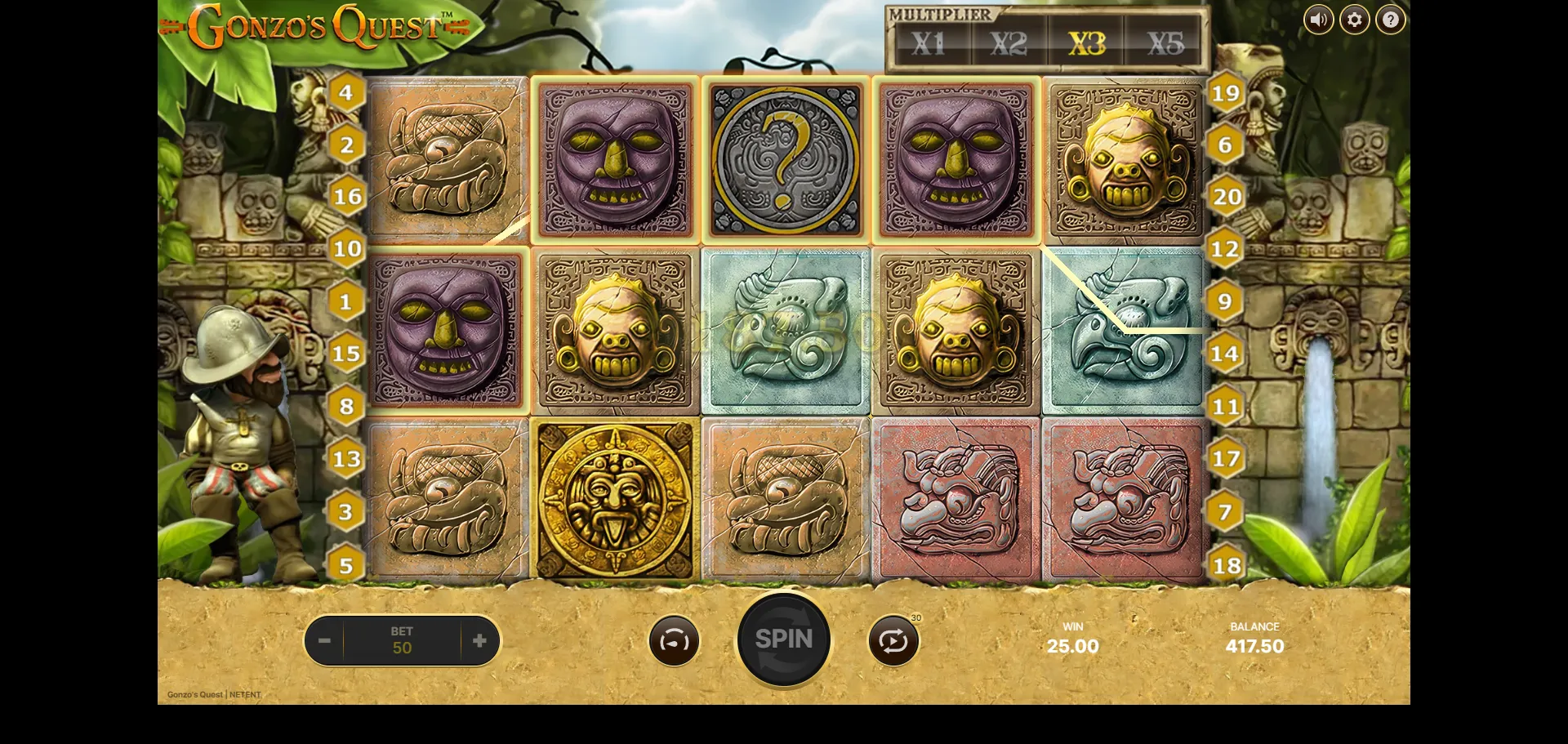
The Wild is a circular stone tile with a "?" mark in Aztec styling. It substitutes for all standard symbols and pays the highest possible combination on any active line where it appears.
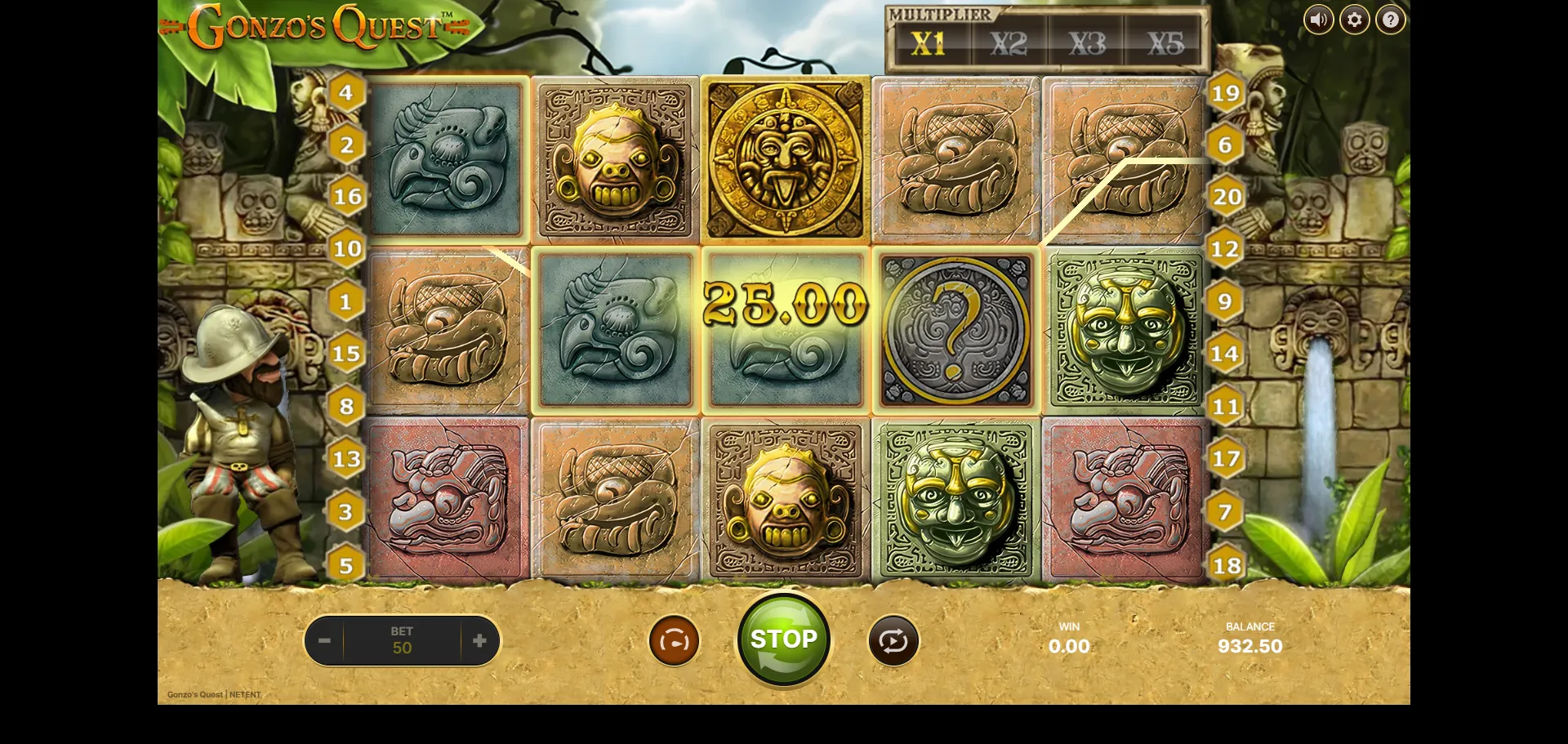
The Wild appears on the three center reels only - reels 2, 3, and 4 - and never on reels 1 or 5. This is documented in the in-game rules and I confirmed it across the session: Wild appearances were always on the center reels. In practical terms, any combination that requires reel-1 or reel-5 coverage to complete cannot be filled by the Wild. Most mid-premium Avalanche wins do not depend on the outer reels, but the exclusion narrows the Wild's reach compared to a true five-reel implementation.
In session, I tracked Wild behavior closely - Wilds landing on the center reels with the multiplier advancing mid-cascade. The operator reference captures show a base-game Wild Avalanche resolving with the multiplier at 3x: a $25.00 win at $50 bet (0.5x stake), an example of how mid-chain Wild combinations resolve in the base game before any Free Falls trigger.
Paytable and Symbol Values
The grid is filled by higher-value Aztec mask symbols and lower-value carved-stone symbols. The top three by payout are the silver-blue mask, the green mask, and the gold idol. Per-line payout values as listed in the in-game paytable (these scale proportionally with the bet level):
- Silver-blue Aztec mask (top symbol): 5-of-a-kind 125.00 / 4-of-a-kind 12.50 / 3-of-a-kind 2.50
- Green mask (second): 5-of-a-kind 50.00 / 4-of-a-kind 5.00 / 3-of-a-kind 1.00
- Gold idol (third): 5-of-a-kind 25.00 / 4-of-a-kind 2.50 / 3-of-a-kind 0.75
The paytable displays dynamic values and updates when the bet level changes - higher bets scale every payout up proportionally, lower bets scale them down.
Hit frequency from the provider page is published at 41%. That 41% counts each Avalanche cascade as a separate event. Counted per spin (where one spin can include several cascades), my session showed roughly one paying spin in 14.

My 523-Spin Demo Session
I ran 523 spins in the NetEnt demo at $2 per spin. The demo balance reset to $1,000 several times during the session (NetEnt demo refreshes the token balance periodically) - that did not affect spin counts or observed Avalanche behavior.
Session Stats
Hit rate across the session landed at about one paying spin in fourteen. The longest losing run I tracked was 47 consecutive spins without a win. For medium-high variance, that is a moderate dry stretch - not a statistical extreme. I recorded two runs above 30 spins within the session.
Gonzo's reaction animations tracked cleanly throughout - his jump-and-arm-raise response to a win is timed to the outcome rather than running on a background loop, so a win response reads as a genuine signal rather than ambient decoration. During cold stretches his foot-tap animation activates - it reads as the game acknowledging a dry run, which is a design choice I noticed and did not expect.
The three speed settings - Regular, Quick, and Super Quick - affect the cascade animation pace enough to matter for analysis. I ran Regular speed for most of the session. Super Quick compresses the Avalanche display to a point where tracking the multiplier counter mid-chain becomes unreliable. For detailed review work, Regular or Quick is the appropriate choice.
The highest single result in my session came from a supplementary screenshot at $50 bet: $732.50, or 14.65x stake. That result was a base-game Avalanche chain without a Free Falls trigger, with the avalanche multiplier at 1x on that win (the X2/X3/X5 steps unlit). Free Falls did not occur across the 523 spins I ran.
Session effective return settled around 84% - about $877 returned across the $1,046 wagered (523 spins x $2 per spin) - well below the 95.97% theoretical. This is the expected outcome when no Free Falls trigger in a 523-spin run: the highest-yield event type is absent from the entire sample. These figures reflect one demo run and are not predictive.
Test limitations: This is a single demo session on a small sample. Free Falls did not trigger across the 523 spins, so the bonus screen and its 15x sequence are documented from the in-game Rules rather than direct play. The session return (~84%) and the longest dry run (47 spins) describe this one run only and do not predict real-money outcomes.
Pros and Cons
Strengths
- RTP 95.97% confirmed directly from the in-game Rules - verifiable without citing an aggregator
- Avalanche mechanic produces multiple win evaluations per spin event at the same bet size
- Progressive multiplier in the base game (max 5x) attaches value to chain position
- Free Falls multiplier starts at 3x and reaches 15x with no reset between free spins
- Published hit frequency (41%) is documented with a source
- MGA license documentation is complete and verifiable
Limitations
- No bonus buy - Free Falls cannot be purchased directly
- Wild covers only the center reels (2, 3, 4) - not reels 1 or 5, so outer-reel completions cannot be filled
- Free Falls trigger requires scatters on reels 1+2+3 specifically - very strict condition
- No gamble feature
- At minimum bet ($0.20), low-symbol payouts are fractional
- RTP 95.97% sits below comparable titles from the same era (see comparison below)
How Gonzo's Quest Compares
Across all three comparable titles from the same era, Gonzo's Quest's 95.97% RTP sits at the bottom. The Avalanche multiplier is structurally distinctive and genuinely differentiating. On return rate, though, it is outcompeted by each title in this group.
| Game | Provider | RTP | Volatility | Key Feature |
|---|---|---|---|---|
| Gonzo's Quest | NetEnt | 95.97% | Medium-High | Avalanche + 15x Free Falls |
| Starburst | NetEnt | 96.09% | Low | Expanding Wild, both-ways pays |
| Thunderstruck II | Microgaming | 96.65% | Medium-High | 4-level progressive bonus system |
| Book of Dead | Play'n GO | 96.21% | High | Expanding symbol Free Spins |
Gonzo's Quest vs Starburst: Starburst runs at 96.09% RTP and low variance, with an expanding Wild on reels 2-4 and both-ways pays. It produces frequent small wins without the multiplier ceiling. Gonzo's Quest has a higher ceiling per bonus event but a slower base game.
Gonzo's Quest vs Thunderstruck II (Microgaming, 2010): Thunderstruck II is from the same era with a 96.65% RTP - the highest in this comparison. It uses a four-level bonus system that unlocks progressively across sessions. Gonzo's Quest offers a more transparent base-game mechanic with the multiplier always visible. The RTP difference (96.65% vs 95.97%) is material over extended play.
Gonzo's Quest vs Book of Dead (Play'n GO): Both are medium-high variance. Book of Dead's Free Spins ceiling depends on which symbol expands; Gonzo's Quest's Free Falls ceiling depends on the multiplier chain depth. The RTP comparison (96.21% vs 95.97%) favors Book of Dead.
Frequently Asked Questions
What is the RTP of Gonzo's Quest?
How does the Avalanche feature work?
What is the maximum win?
How do I trigger Free Falls?
What is the volatility?
Is there a bonus buy?
What is the bet range?
Does the Wild appear on all five reels?
About This Review

How this review was built
One manual demo session on the NetEnt demo, March 2026. Per-claim provenance:
- Session: 523 spins at $2 per spin, tracked by hand - hit rate, dry streaks, multiplier behavior.
- Feature rules (Avalanche, multiplier sequences, Free Falls trigger, Wild reel coverage): in-game Help/Rules via the NetEnt demo.
- RTP 95.97%: in-game Rules screen, confirmed on netent.com/games/gonzos-quest.
- Max win 2,200x: netent.com/games/gonzos-quest.
- Volatility Medium-High: cross-verified across AskGamblers, SlotCatalog, and slots.info.
- Paytable and big-win frames: operator reference captures taken at $50 bet (labelled as such on each figure).
- Free Falls: did not trigger across the 523 spins; the bonus screen is documented from the Rules, not direct play.